
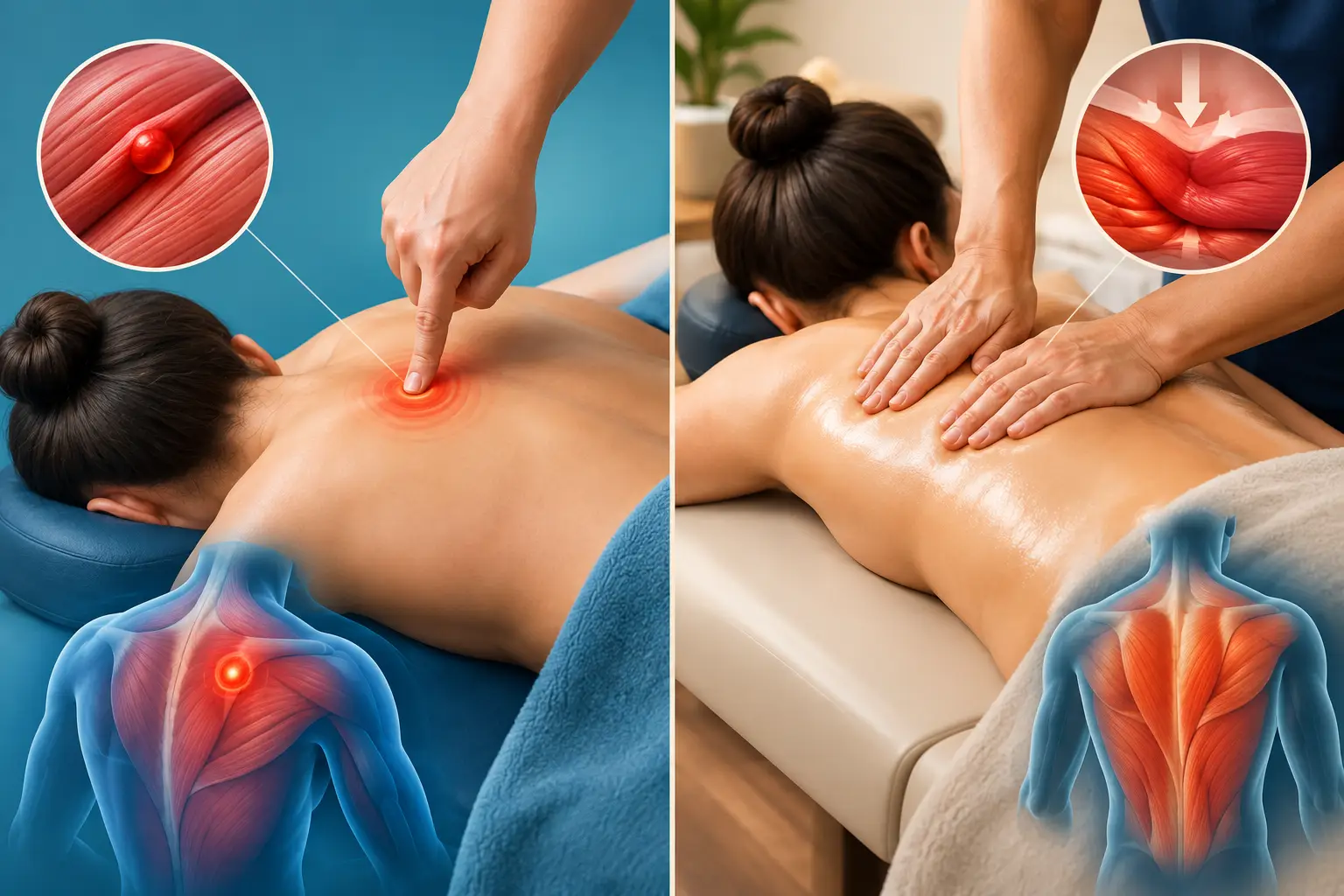
That knot between your shoulder blade and spine may not need the same work as the dense, achy tightness across your entire back. When clients ask about trigger point versus deep tissue massage, they are usually trying to answer one practical question: “What will actually help my body feel better?”
Both approaches can be powerful tools for pain relief, stress reduction, recovery, and easier movement. But they are not interchangeable. A thoughtful massage session starts with what you are feeling, where you feel it, how long it has been there, and what your body can comfortably receive that day.
Trigger Point Versus Deep Tissue: The Key Difference
Trigger point therapy is highly focused. It addresses specific tight, sensitive spots within muscle tissue that can create pain locally or refer discomfort somewhere else. That tender point in your upper trapezius, for example, may contribute to an aching neck, a tension headache pattern, or pain that travels toward the shoulder.
Deep tissue massage is broader in its purpose. It uses slower, more deliberate pressure to work with chronic tension in deeper muscle layers and connective tissue. Rather than concentrating only on one painful spot, it may address the larger pattern around it: restricted hips, overworked legs, a stiff low back, or shoulder muscles that have been bracing through long workdays.
Think of trigger point work as precise attention to a stubborn hotspot. Deep tissue is more like addressing the dense landscape surrounding that hotspot. A skilled therapist may use both in the same session, because the body rarely keeps its tension in one neat little location!
What Trigger Point Therapy Feels Like
A trigger point is often described as a knot, though it is more accurately an irritable area in a tight band of muscle. You may recognize it right away when pressure lands on it: “Yep, that’s the spot.” The sensation can be intense, tender, or surprisingly familiar. Sometimes it creates referred sensation away from where the therapist is applying pressure.
During trigger point therapy, the therapist locates the area and applies sustained, tolerable pressure or uses small, specific movements to encourage the tissue to soften. The goal is not to overpower your body. It is to work with enough precision and patience that the muscle can let go of unnecessary guarding.
This approach can be especially useful for people dealing with recurring neck and shoulder tightness, jaw tension, glute discomfort, calf tightness, forearm strain from computer or hands-on work, and localized pain after repetitive activity. Athletes may also benefit when a particular area keeps interfering with training or recovery.
Trigger point work can bring a strong “good hurt” feeling, but stronger is not automatically better. Holding your breath, tightening against the pressure, or feeling sharp pain is a sign that the approach needs to change. Productive therapeutic work should still leave room for your nervous system to feel safe.
What Deep Tissue Massage Feels Like
Deep tissue massage is often misunderstood as massage that must be extremely hard. It is not a pressure contest. The “deep” part refers to intentional work with deeper structures and chronic holding patterns, using slow strokes, focused pressure, and thoughtful pacing.
For someone who spends hours at a desk, commutes across Philadelphia, works on their feet, lifts at the gym, or carries stress in their body, deep tissue work can help create a sense of space where the body has felt compressed. The therapist may spend time with the back, hips, thighs, shoulders, and chest, depending on your goals and movement patterns.
You may feel a steady, spreading pressure rather than one sharp point of intensity. Because deep tissue massage often covers larger areas, it can be a strong choice when tightness feels widespread or when you want to improve overall mobility alongside stress relief.
It may be appropriate for persistent muscular tension, post-workout soreness, limited range of motion, and the familiar feeling of being “tight everywhere.” Still, deep tissue is not always the best choice after a fresh injury, during an acute flare-up, or on a day when your body is already depleted. Your session should be adjusted to your condition, not forced into a preset style.
When One Approach May Be Better Than the Other
Choose trigger point-focused work when your discomfort feels specific. Maybe there is one spot at the base of your neck that keeps returning, a knot near your shoulder blade, or a glute area that feels like it is affecting how you walk. The more pinpointed the complaint, the more useful precise work may be.
Deep tissue may make more sense when the issue is a larger, long-standing pattern. If your entire upper back feels heavy after weeks of deadlines, your hips and legs are restricted from training, or your lower body feels chronically dense after standing at work, broad, slow therapeutic massage may offer more complete support.
But the answer is often both. A tight trigger point does not appear in isolation. Your body may be compensating around it, and the neighboring muscles may need attention too. Starting with broad warming work, moving into focused trigger point therapy, then returning to longer strokes can help the session feel effective without becoming punishing.
Pressure Is Personal, Not a Badge of Honor
Many people arrive believing a massage only counts if they leave sore for days. That belief can lead to sessions that are too aggressive, too fast, or simply mismatched for the body’s needs. Some post-massage tenderness can happen, particularly after deep work in chronically tight areas. Severe pain, bruising, or a major increase in symptoms is not the goal.
The most useful pressure is the amount that creates a therapeutic response while allowing you to breathe and relax into the work. Your hydration, sleep, stress level, activity schedule, and health history all influence what that feels like on a particular day.
Speak up during your session. Say whether the pressure is too much, too light, sharp, numb, or exactly right. Let your therapist know if an area refers pain somewhere unexpected. That feedback is not interrupting the massage. It is how personalized bodywork becomes more effective.
A Few Times to Pause Before Booking Deep Work
Massage therapy can be a valuable part of an integrated wellness routine, but it does not replace medical evaluation. If you have sudden severe pain, unexplained swelling, redness or warmth in an area, fever, numbness, weakness, a recent fracture, a blood clot history, or a new injury, consult an appropriate medical professional before receiving targeted deep pressure.
The same applies if you are pregnant, managing a serious health condition, taking blood thinners, recovering from surgery, or navigating a condition that affects sensation or circulation. A qualified massage therapist can adapt a session in many situations, but clear communication and appropriate medical guidance come first.
Make Your Massage Match Your Real Life
The best massage is not the one with the toughest-sounding name. It is the one that meets you where you are. A runner preparing for a race may need focused calf and hip work. A teacher carrying stress through the shoulders may need a blend of deep tissue techniques, trigger point therapy, and relaxation-based massage. A first-time client with touch deprivation and high stress may benefit from a gentler pace before more targeted work.
At Life4orceTouch, each session is shaped around your goals, your comfort level, and what your body is communicating in the moment. Whether you need concentrated attention on one stubborn knot or a fuller therapeutic reset, you deserve care that is never one-size-fits-all.
Pay attention to the pattern, not just the pain. Notice when the discomfort appears, what makes it worse or better, and whether it feels like one small hotspot or a body-wide buildup. Bring those details to your next massage, and you will have a much better starting point for feeling lighter, moving easier, and getting back to what you love.