
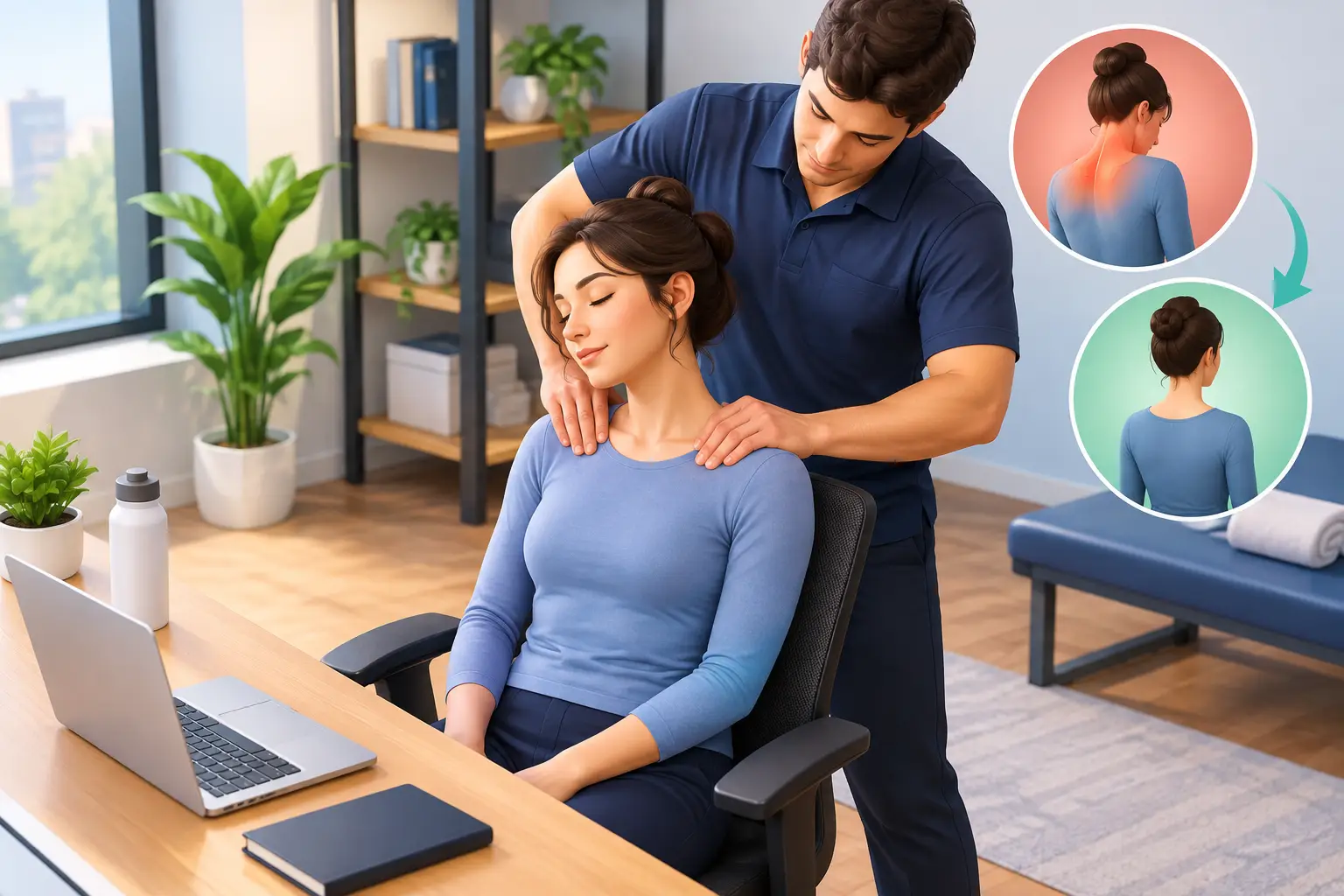
A full workday can leave your body feeling like it has been folded into the shape of your chair. Your neck resists turning, your shoulders creep toward your ears, your low back aches when you stand, and even your hands may feel tired from hours on a keyboard. Understanding how bodywork treats desk stiffness starts with recognizing that this discomfort is rarely about one “bad” muscle. It is often a whole-body pattern built through repetition, stress, limited movement, and a workstation that asks the same tissues to work all day.
For busy professionals across West Philadelphia and the greater Philadelphia area, therapeutic massage can be a powerful reset. The goal is not simply to rub sore spots for an hour. Thoughtful bodywork looks at where you feel the restriction, what may be feeding it, and which techniques can help your body move, breathe, and recover more comfortably.
Why desk stiffness can feel so widespread
Desk work is not automatically harmful. The challenge is staying in any position too long, especially when that position includes a forward-reaching head, rounded shoulders, bent hips, and hands working in a small range of motion. Muscles around the neck, chest, forearms, hips, and low back can become overworked, while other areas contribute less than they need to.
Stress adds another layer. When a deadline is looming or your inbox will not quit, many people brace without realizing it. The jaw tightens, breathing gets shallow, shoulders lift, and the nervous system stays on alert. That is why a stiff neck after a demanding week may not respond fully to stretching alone. The issue can be muscular, connective-tissue related, and stress-related at the same time.
Bodywork does not erase the fact that you have a desk job. It can, however, interrupt the cycle of tension and help you better recognize what your body needs before stiffness becomes the background noise of every day.
How bodywork treats desk stiffness from the neck down
A personalized session begins with listening. Is your discomfort concentrated at the base of the skull? Do you get a pulling feeling between the shoulder blades? Does your hip pinch when you rise from your chair? Are your wrists and forearms sore after computer work? These details help determine where to begin and how much pressure is appropriate.
Releasing overworked neck and shoulder muscles
The upper trapezius, levator scapulae, scalenes, and smaller muscles around the shoulder blades often work overtime during screen-heavy days. Swedish massage may be used first to warm tissues and reduce guarding. From there, deeper focused work, trigger point therapy, or careful work around the shoulder blade may address areas that feel dense, tender, or stuck.
More pressure is not always better. If a muscle is highly irritated or you arrive already stressed and bracing, aggressive work can make you tense further. A skilled therapist adjusts pressure, pace, and technique to help the area soften rather than fight back.
Opening the front of the body
When your arms remain in front of you for hours, the chest and front shoulder tissues may become short-feeling and restricted. Meanwhile, the muscles of the upper back have to work hard to hold your shoulders in place. Addressing only the painful spot between the shoulder blades can provide temporary relief, but including the chest, front shoulders, and arms often creates a more complete change.
Myofascial release is especially helpful here. Fascia is the connective tissue that surrounds and links structures throughout the body. Slow, sustained techniques can help reduce the feeling of tightness across the chest, ribs, shoulders, and upper back without relying only on heavy pressure.
Giving the low back and hips more options
Sitting keeps the hips flexed for long periods. Some people feel this as a stiff low back; others notice it when climbing stairs, squatting, walking after work, or trying to exercise. Therapeutic massage can address the glutes, hip rotators, hamstrings, and muscles around the pelvis that influence how the low back feels.
Thai yoga massage can be a wonderful option for clients who want assisted stretching and movement along with hands-on compression. It may be a good fit when the body feels generally compressed and sluggish rather than sharply painful. Deep tissue work may be useful for more persistent muscular tension, but it should be tailored to your tolerance and current condition.
Caring for wrists, forearms, and hands
Typing, mousing, scrolling, and gripping a phone can create fatigue in the forearms and hands. Gentle massage and focused trigger point work may help ease muscular tension in these areas, while attention to the shoulders and neck can support the entire chain above them.
Numbness, tingling, loss of grip strength, swelling, or pain that wakes you at night deserves medical evaluation. Massage may complement care in some cases, but it should not replace a diagnosis when symptoms could involve a nerve injury or another medical condition.
The nervous system matters as much as the muscles
One reason a good massage can feel so different from stretching at your desk is the environment. You are not answering messages. You are not holding your own posture together. You have permission to be still while someone gives focused attention to what your body has been carrying.
Relaxation-oriented work, including Swedish massage, hot stone massage, shiatsu, Reiki, or craniosacral bodywork, may help clients shift out of a high-alert state. For a person whose desk stiffness is fueled by long hours, poor sleep, and constant pressure, calming the nervous system can be part of the therapeutic plan, not an extra.
That does not mean every session needs to be quiet and sleepy. Some clients want invigorating deep tissue work before a workout or after a demanding project. Others need slower, gentler care because they are depleted. The best approach depends on your goals, health history, activity level, and how your body responds that day.
What makes desk-focused bodywork more effective
A single massage can bring meaningful relief, especially when you have been carrying tension for weeks. But the benefits tend to last longer when bodywork is paired with small changes between appointments. You do not need a perfect ergonomic setup or an hour-long mobility routine to make progress.
Try standing up for a brief walk, changing your visual focus away from the screen, rolling your shoulders, or taking several slow breaths once each hour. Place your keyboard and mouse close enough that you are not constantly reaching. If possible, vary your position instead of chasing one “perfect” posture. The body usually responds well to movement variety.
Hydration, regular sleep, strength training, and walking can also support recovery. Still, it depends. If you are in a flare-up, pushing through an intense workout or forceful stretching may aggravate sensitive tissues. A therapist can help you understand whether your body seems to need calming, mobility, strength support, or referral to another health professional.
What to expect in a personalized session
At Life4orceTouch, bodywork is not a standardized spa routine. Your session can incorporate modalities such as deep tissue massage, myofascial release, trigger point therapy, cupping, Thai yoga massage, or soothing Swedish techniques based on what your body is asking for. You can speak up about pressure, sensitive areas, old injuries, and what has or has not helped in the past.
Cupping may be considered when tissues feel especially restricted or when you want a technique that can create a broad decompressive sensation. It can leave temporary circular marks, so it may not be ideal right before an event where you prefer no visible marks. Hot stones can add comforting warmth for clients who respond well to heat, while Thai reflexology may be a welcome addition for people whose feet ache after commuting, standing, or workouts.
The point is choice. Your treatment should fit your real life, whether you are a laptop-bound professional, an athlete with a packed training schedule, a parent balancing too much, or someone simply tired of ending every day in pain.
When massage is not the whole answer
Bodywork is valuable supportive care, but it has limits. Seek medical attention promptly for chest pain, sudden severe headache, unexplained weakness, changes in bladder or bowel control, fever, significant swelling, or pain following a major fall or accident. Persistent tingling, radiating pain, or symptoms that steadily worsen should also be assessed by an appropriate medical provider.
For many desk workers, the most effective path is integrated care. Massage therapy may work alongside physical therapy, chiropractic care, exercise coaching, medical treatment, or stress-management support. There is no prize for handling chronic discomfort alone.
Your body does not need to earn care by becoming unbearable first. A regular bodywork appointment can be a practical pause in a packed week: time to release the tension, notice the patterns, and leave with a little more room to move. That is a powerful way to support yourself while also supporting a local West Philadelphia small business!